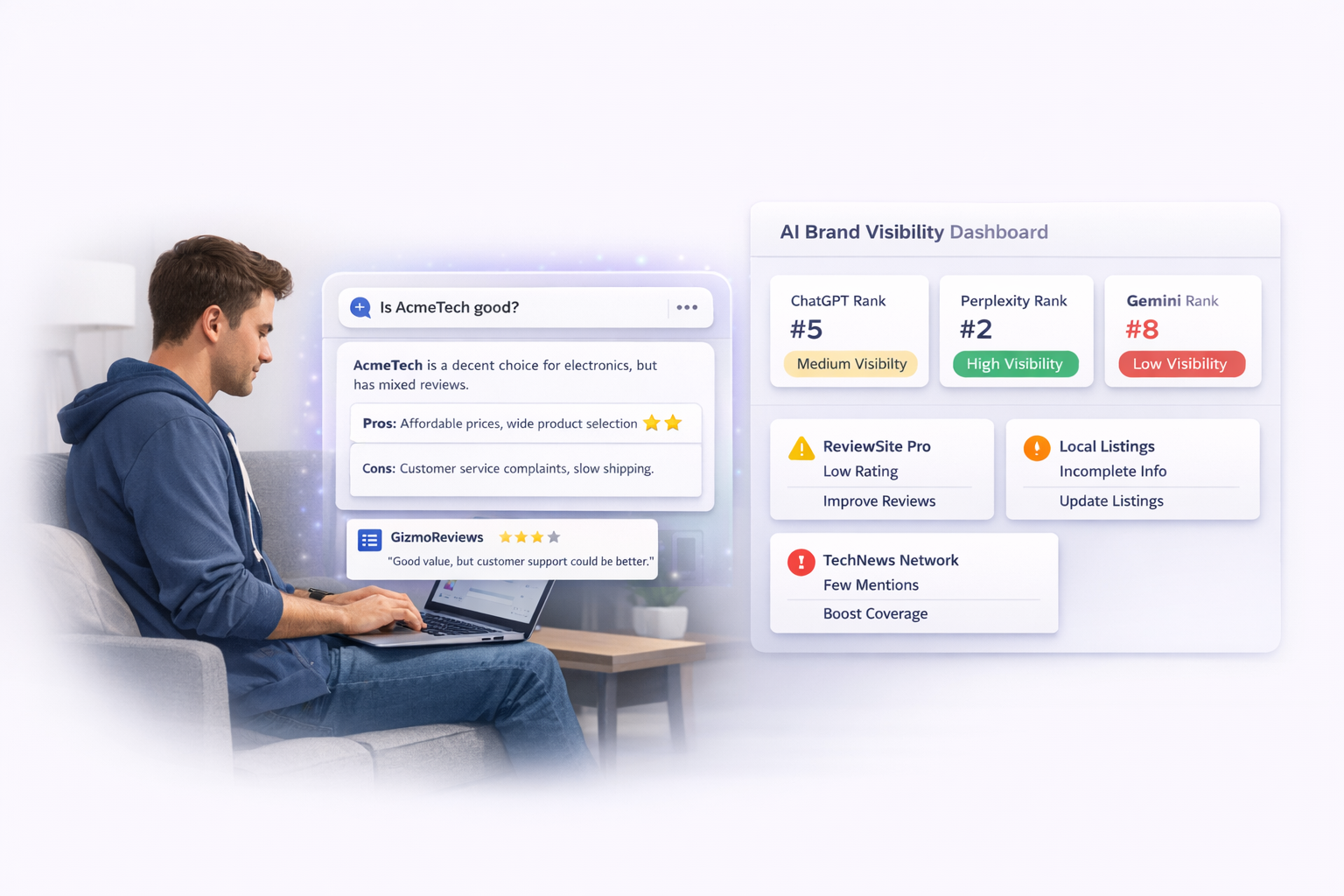
A customer asks ChatGPT: "What's the best pizza chain for families in Mumbai?" The AI answers confidently, names three brands, and explains why. Your brand — with 50 locations across the city — isn't mentioned. That customer never even knew you existed.
This isn't a hypothetical scenario. It's happening right now, millions of times a day. ChatGPT processes 2.5 billion prompts daily. Perplexity handles 780 million queries per month. Google's AI Overviews now appear on over half of all search results. The way people discover businesses has fundamentally changed — and most brands haven't caught up.
In this article, we'll break down the numbers behind the AI search revolution, show you why multi-location brands are at the highest risk of invisibility, and explain how BizLoc8's AI Visibility platform helps you take control.
The AI Search Explosion: The Numbers You Can't Ignore
Let's start with what's actually happening. The shift from traditional search to AI-powered discovery isn't gradual — it's exponential.
ChatGPT: From Zero to a Billion
ChatGPT crossed 1 billion monthly active users in January 2026, up from 358 million just 12 months earlier. It now handles roughly 12–18% of Google's daily search volume. That's not a niche tool anymore — it's a mainstream search engine.
Perplexity: The Fastest-Growing Search Engine You're Not Tracking
Perplexity AI's query volume tripled in under a year — from 230 million monthly queries in mid-2024 to 780 million by May 2025, with 20% month-over-month growth. It's projected to cross 1.5 billion queries per month by mid-2026.
Overall AI Search Traffic
Unique visitors to AI search platforms doubled year-over-year — from 338 million in August 2024 to 743 million in August 2025. That's a 150% increase in just 12 months.
Key Stat
77% of Americans have used ChatGPT as a search engine. 24% now choose it before Google. The question isn't whether your customers are using AI search — it's whether they're finding you when they do.
Google Is Losing Ground — and Eating Its Own Traffic
Google still dominates with ~90% global market share. But cracks are forming:
- Desktop searches per user in the US fell nearly 20% year-over-year in Q4 2025 (Datos/SparkToro)
- Google's share of general information searches dropped from 73% to 66.9% between February and August 2025
- ChatGPT's share of general searches tripled to 12.5% in the same period
- Gartner predicts traditional search volume will drop 25% by end of 2026
But here's the twist: Google itself is accelerating the shift. Google AI Overviews — the AI-generated summaries that appear at the top of search results — now trigger on 58% of all queries, up from 12% in mid-2024.
The Zero-Click Crisis
When AI answers the question directly, users don't click through to your website.
- 65%+ of all Google searches now end without a click (Q1 2026)
- When AI Overviews appear, the zero-click rate jumps to 83%
- Organic click-through rates dropped 61% for queries with AI Overviews
- 93% of searches in Google's AI Mode end without a single click
What This Means for Your Brand
Even if you rank #1 on Google, you may be getting dramatically fewer clicks than a year ago. The traffic isn't disappearing — it's being captured by AI-generated answers. If those answers don't mention your brand, you're invisible twice: once on AI platforms, and once on Google itself.
Your Customers Have Already Moved to AI
This isn't a future trend. Consumer behavior has already shifted:
- 58% of consumers used AI tools to search for local businesses in 2025 — up from just 19% the year before (BrightLocal)
- 71% of Gen Z consumers use chatbots for product discovery
- 53% of all consumers now regularly use generative AI (Capgemini)
- 94% of B2B buyers used an LLM during their buying journey in 2025
The most striking stat? 51% of B2B software buyers now begin their research with an AI chatbot more often than with Google (G2 Research, March 2026). And 69% of those buyers chose a different vendor than initially planned based on what the AI recommended. One in three purchased from a brand they had never heard of — simply because AI surfaced it.
The Opportunity
AI doesn't just redirect existing demand — it creates new discovery paths. Brands that show up in AI recommendations reach customers who would never have found them through traditional search alone.
The Multi-Location Visibility Gap: Only 1.2% Get Recommended
Here's where it gets critical for multi-location brands. SOCi's 2026 Local Visibility Index analyzed 350,000+ locations across 2,751 multi-location brands. The results are sobering:
- Only 1.2% of locations were recommended by ChatGPT
- Only 11% by Gemini
- Only 7.4% by Perplexity
- Compare that to 35.9% appearing in Google's traditional Local 3-Pack
That means AI local visibility is up to 30x harder than ranking in Google's local pack. And unlike Google — which shows three businesses — AI platforms often recommend just one brand. Winner takes all.
Why the Gap Exists
Traditional SEO won't save you here. The SOCi study found that only 45% of brands leading in traditional local search also appeared among the most recommended in AI results. Different platforms, different rules:
- ChatGPT draws from web content, reviews, and public data — business profile accuracy was only 68%
- Gemini is grounded in Google Maps data — 100% accuracy on business info, but selective about what it recommends
- Perplexity cites specific web sources — if your content isn't authoritative and structured, you won't be cited
Each platform has its own signals, its own biases, and its own way of selecting which brands to recommend. Managing this across hundreds of locations requires purpose-built tooling.
The Stakes Are High
AI narrows consumer choice to a single recommended brand in most queries. If you're not that brand, your competitor is. And unlike Google — where you can still appear on page 1 alongside competitors — in AI search, being second often means being invisible.
The Revenue Impact: Small Traffic, Massive Conversions
Some brands dismiss AI traffic because the absolute volume is still small compared to Google. That's a mistake. Here's why:
AI Visitors Convert at 4–5x Higher Rates
- AI search visitors convert at 14.2% vs. organic's 2.8% — approximately 5x higher (Growth Marshal)
- Similarweb data shows AI referrals converting at 11.4% vs. 5.3% for organic across global ecommerce
- ChatGPT ecommerce traffic converts 31% higher than non-branded organic search
- Some datasets show AI-referred visitors converting at up to 23x the rate of traditional organic (Ahrefs)
Why? Because AI users arrive with higher intent. They've already asked their question, compared options, and the AI has pre-qualified your brand as the answer. By the time they click, they're ready to act.
The Cost of Not Being There
On the flip side, brands losing traditional organic traffic to AI are seeing real financial impact:
- HubSpot reported losing 70–80% of organic search traffic
- Business Insider's organic traffic fell 55%, leading to 21% staff cuts
- Gartner projects unprepared brands may see traffic declines of 20–50%
ROI Timeline
AI optimization investment typically shows ROI payback in 90–120 days. Brands that optimize early gain a 3–5x citation advantage over late movers. Only 16% of brands currently track AI search performance — the early-mover window is still open.
What Actually Drives AI Visibility?
AI platforms don't rank pages like Google does. They select brands to recommend based on different signals. Understanding these signals is key:
1. Review Volume and Sentiment
Locations recommended by ChatGPT averaged 4.3 stars. AI platforms weigh review quality heavily — not just star ratings, but the actual content of reviews, recency, and volume. A location with 500 detailed reviews will be cited far more often than one with 20.
2. Structured, Authoritative Content
Up to 90% of citations driving brand visibility in LLMs come from earned media — trusted outlets, authoritative content, and well-structured web pages (Edelman). Your website content needs to be comprehensive, factual, and easy for AI to parse.
3. Consistency Across Platforms
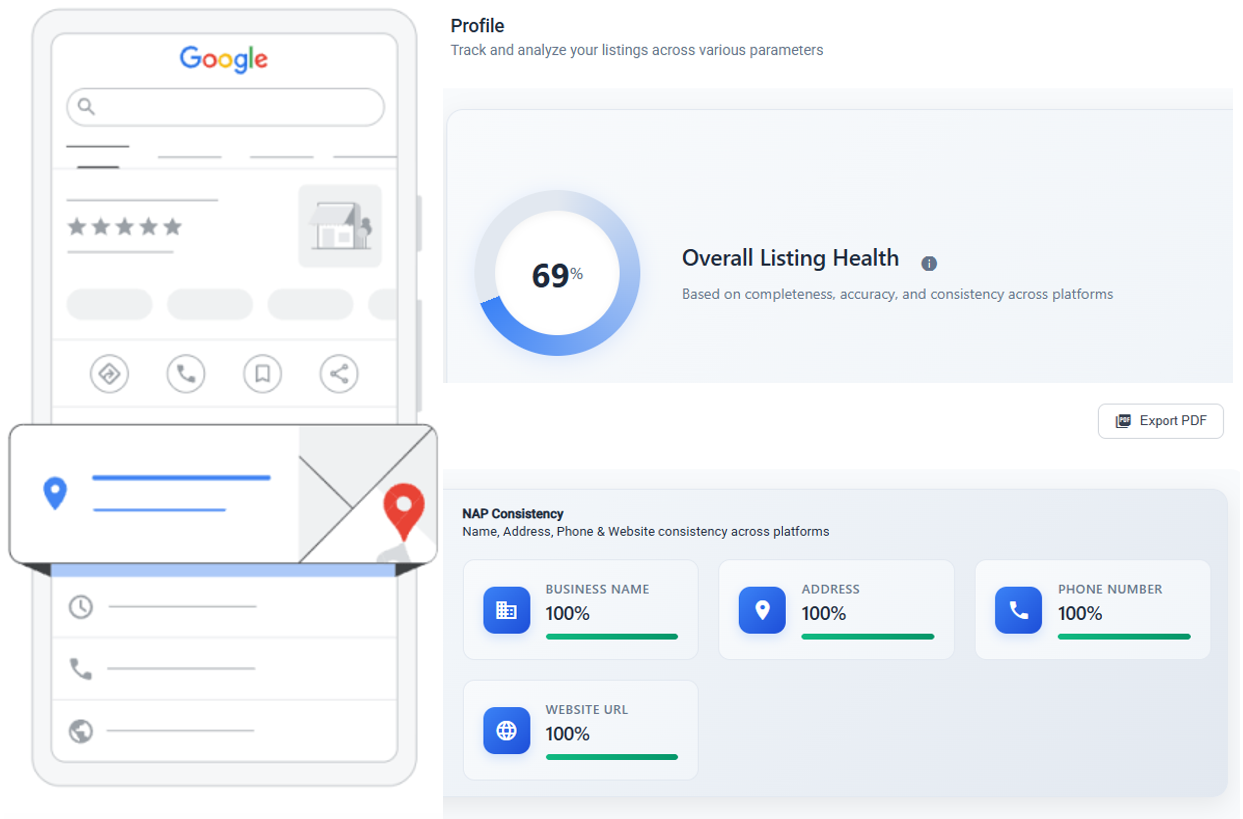
AI cross-references data from multiple sources. If your business hours say one thing on Google and another on your website, the AI may skip you entirely or present inaccurate information. NAP consistency (Name, Address, Phone) matters even more in the AI era.
4. Citation Volatility
AI answers aren't static. Research shows that only 30% of brands remain visible in back-to-back AI responses for the same query. AI Overview content changes ~70% of the time, and when it updates, nearly half the citations are replaced. Continuous monitoring isn't optional — it's essential.
Key Insight
The top 10 domains take 46% of all ChatGPT citations in any given topic. The top 30 take 67%. AI visibility is a winner-take-most game. Getting into that top tier early creates a compounding advantage.
How BizLoc8 Helps You Win in AI Search
BizLoc8's AI Search Visibility platform is built specifically for this challenge. While most SEO tools still focus on Google rankings, BizLoc8 monitors and optimizes your presence across ChatGPT, Gemini, Perplexity, and Claude — the platforms where your customers are actually searching.
Discovery: See How AI Describes Your Brand
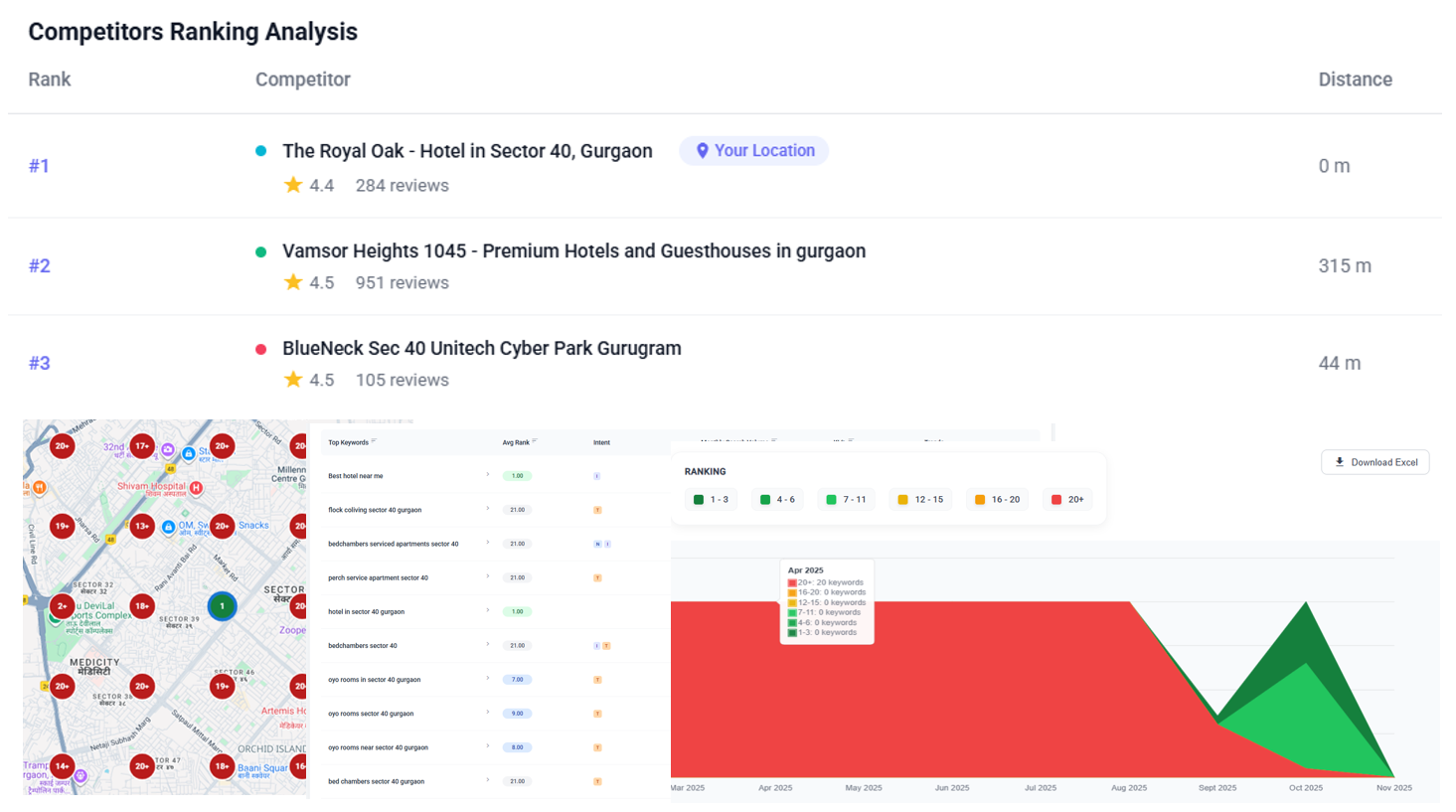
Run automated queries across all major AI platforms to see exactly how they describe your business. Are they recommending you? Are they getting your details right? Are they recommending your competitors instead? BizLoc8 tests this daily with real prompts — so you always know where you stand.
Diagnosis: Understand Why You're Invisible
BizLoc8's diagnostic engine identifies the gaps — whether it's missing citations, inconsistent business data, weak review signals, or content that AI can't parse. It benchmarks your performance against competitors across every platform, showing you exactly where you're winning and where you're losing.
Influence: Take Action to Boost Your Visibility
Get actionable recommendations: AI-optimized content templates, schema markup suggestions, citation-building strategies, and review management guidance. BizLoc8 doesn't just show you the problem — it gives you the playbook to fix it.
Track and Iterate
With citation tracking, query intelligence, and competitive leaderboards, you can monitor your progress over time. See which prompts trigger your brand, which platforms cite you most, and how your visibility score changes week over week.
Built for Multi-Location Brands
BizLoc8 doesn't just check your brand name — it tracks visibility at the location level. Whether you have 10 stores or 1,000, you can see which locations are getting AI recommendations and which are invisible. That's the granularity multi-location brands need.
Your 5-Step AI Visibility Action Plan
Whether you use BizLoc8 or not, here's what every multi-location brand should be doing right now:
Step 1: Audit Your Current AI Visibility
Go to ChatGPT, Gemini, and Perplexity. Ask them to recommend businesses in your category and location. Are you being mentioned? Is the information accurate? This takes 10 minutes and will likely be eye-opening.
Step 2: Fix Your Data Foundation
Ensure your Google Business Profile, website, and all directory listings have consistent, accurate, and complete information. AI platforms cross-reference multiple sources. Inconsistencies reduce your chances of being recommended.
Step 3: Invest in Review Volume and Quality
AI platforms favor businesses with strong review signals. Actively encourage customers to leave detailed reviews. Respond to every review — AI considers review engagement as a quality signal.
Step 4: Create AI-Parseable Content
Structure your website content with clear headings, FAQ sections, schema markup, and factual claims. Make it easy for AI to extract and cite your information. Think: "What would an AI need to confidently recommend my business?"
Step 5: Monitor Continuously
AI answers change constantly. What works today may not work next month. Set up ongoing monitoring to track your visibility, catch drops early, and adapt your strategy. This is where a platform like BizLoc8 becomes essential.
The Bottom Line
The numbers tell the story: 1 billion people on ChatGPT. 780 million queries on Perplexity. 58% of consumers using AI for local discovery. Yet only 1.2% of multi-location brand locations get recommended by AI platforms.
This is the biggest visibility gap in digital marketing since the early days of Google. The brands that close it now — by understanding how AI selects recommendations, optimizing their data and content, and monitoring their presence across platforms — will own the next decade of customer discovery.
The brands that don't? They'll watch their competitors get recommended instead, one AI answer at a time.
Find Out If AI Is Recommending Your Brand
Run a free AI visibility audit with BizLoc8. See how ChatGPT, Gemini, and Perplexity describe your business — and what you can do to improve your visibility across every AI platform.
Get Your Free AI AuditRelated Articles