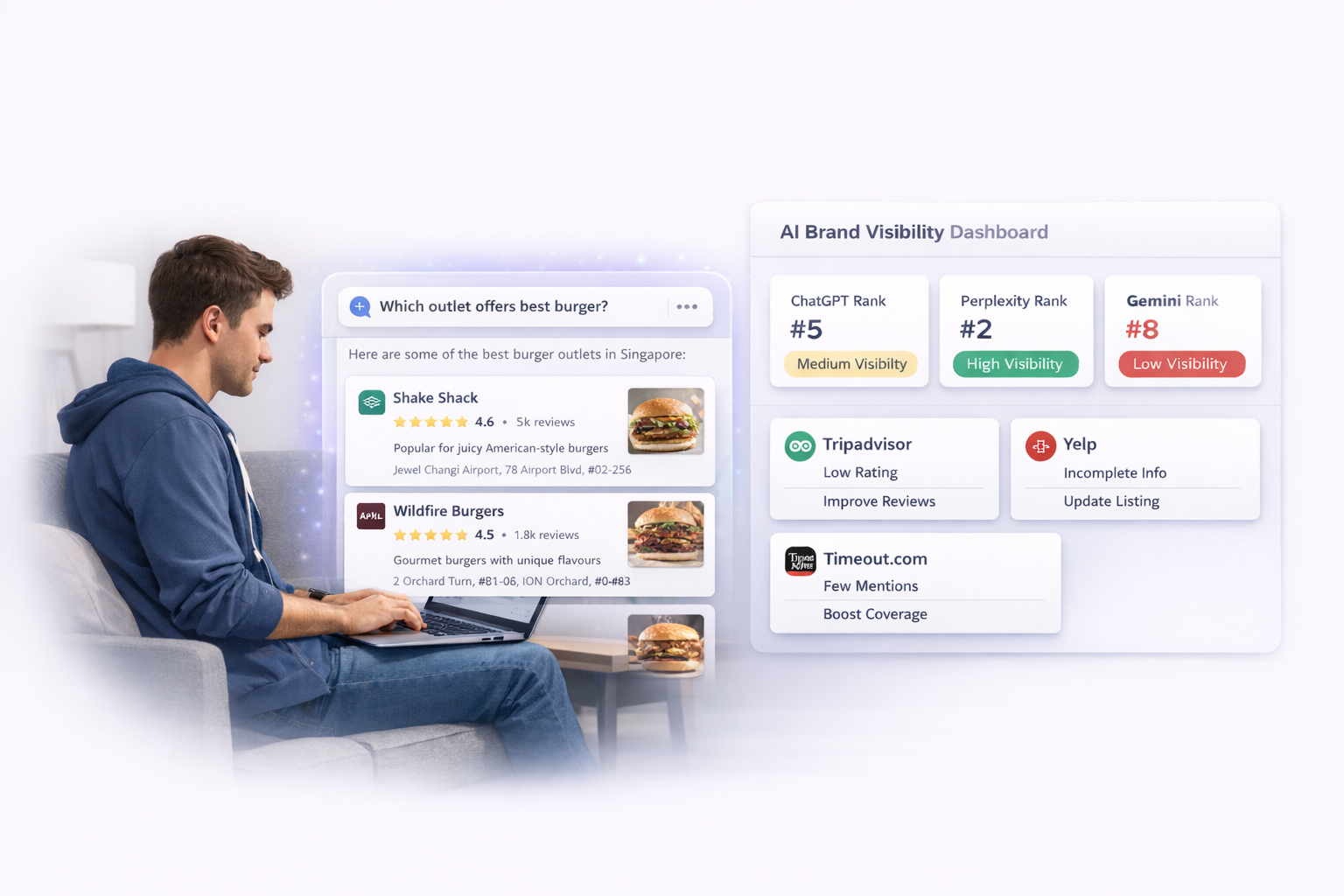

There is no single best AI visibility tool. There is the best one for your size, your budget, and whether you just want to watch how AI engines talk about you or actually do something about it.
AI visibility tools, sometimes called AEO (answer engine optimization) tools, all try to answer one question: when a buyer asks ChatGPT, Gemini, Perplexity or Google's AI Overviews about your category, does the answer name you? Below is an honest, grouped look at the main options in 2026, who each is right for, and the gap most of them still leave open.
Our pick, if local matters to you
Most tools here track AI answers at the brand level. BizLoc8 tracks them per location, alongside a full local SEO toolkit. Full disclosure: it's ours, so the honest look at every alternative is right below.
What an AEO tracking tool actually does
Strip away the branding and these tools do some mix of five jobs. Nothing does all five equally well, so buy for the one you care about most:
- Mention and citation tracking: how often each engine names you, and whether it links a source when it does
- Share of voice: your visibility against named competitors for the same prompts
- Source analysis: which pages and sites the answers cite, so you know what to earn or improve
- Prompt and engine coverage: how many questions, and across which engines (ChatGPT, Gemini, Perplexity, Copilot, Google AI Overviews)
- Recommendations: concrete next steps to get cited more often, not just a score
If you are new to the category, start with what AI search visibility is and how AI engines choose which brands to recommend, then come back to pick a tool.
Enterprise AEO tracking platforms
Profound
One of the best known names in the space, built for enterprise teams that want deep answer-engine analytics: citation patterns, share of voice, and how prompts break down across engines at scale. It is powerful, and it is priced and scoped for larger brands rather than a solo marketer.
Best for: enterprise brands that want serious, large-scale AI answer analytics.
BrightEdge
A long-standing enterprise SEO platform that has added generative and AI Overview tracking to its content and rank data. If your organisation already runs BrightEdge for SEO, its AI features are a natural extension rather than a new contract.
Best for: large teams already invested in BrightEdge for enterprise SEO.
Conductor
Another enterprise content and SEO platform that now reports on AI Overviews and answer visibility alongside its organic research. Same logic as BrightEdge: strongest if it is already part of your stack.
Best for: content-led enterprise teams wanting AI visibility inside their existing platform.
SMB and mid-market AEO trackers
Otterly.ai
A focused, approachable AEO monitor. You add your prompts, pick your engines, and it tracks mentions, links and share of voice without an enterprise onboarding. A good first tool for a small team that wants to see the picture quickly.
Best for: SMBs and agencies that want AI monitoring live in an afternoon.
Peec AI
A newer, well-designed AI visibility analytics tool that has gained traction with European teams. Clean reporting on brand mentions and competitor share across the main engines.
Best for: mid-market brands and agencies that want tidy, shareable AI visibility reports.
Scrunch AI
Leans into managing and improving how your brand shows up across AI platforms, not just watching it. Useful if you want the tool to nudge you toward action rather than hand you a dashboard and stop there.
Best for: teams that want guidance on fixing AI presence, not only measuring it.
Goodie AI
An AEO-first platform aimed at helping brands get discovered and cited by answer engines, pairing monitoring with content direction. Worth a look alongside Otterly and Peec when you shortlist.
Best for: brands that want monitoring and content guidance in one lighter tool.
SEO suites that added AI tracking
Semrush
Semrush has folded AI and answer-engine tracking into its wider suite, so you can watch AI mentions next to keyword and backlink data. It makes most sense if you already pay for Semrush, because you are buying the whole platform to use this slice of it.
Best for: teams already living in Semrush. (Semrush Local vs BizLoc8)
Ahrefs (Brand Radar)
Ahrefs added tracking for brand mentions in AI Overviews and answer engines on top of its strong backlink and keyword data. Solid if Ahrefs is already your SEO home base.
Best for: SEO teams that want AI mention data inside Ahrefs.
The gap most tools leave: local
Almost every tool above tracks AI answers at the brand level, for one national conversation. But a huge share of AI questions are local. Someone asks for the best clinic, dealership or restaurant near them, and the engine returns a short list of names tied to that place. The answer in one city is not the answer in the next, and a brand-level score cannot see that.
Why this matters now
You can sit at the top of the map pack and still be missing from the AI answer your buyer reads. We break down how engines decide in How AI Engines Actually Choose Which Brands to Recommend.
BizLoc8 is built for that gap. It runs your real buyer questions through ChatGPT, Gemini and Perplexity per location, so you see which outlet gets named where, where a competitor is winning the answer, and which sources you would need to earn to change it. And it does that next to the local SEO basics: Google Business Profile management, listings, reviews and geo-grid rank tracking, on one screen.
Best for: local and multi-location brands that want AI-answer visibility and local SEO in one place. (For the record: BizLoc8 is ours.)
AEO tracking tools compared at a glance
| Tool | Best for | AI mentions | Share of voice | Source analysis | Per-location | Local SEO |
|---|---|---|---|---|---|---|
| BizLoc8 | AI answers + local SEO | ✓ | ✓ | ✓ | ✓ | ✓ |
| Profound | Enterprise analytics | ✓ | ✓ | ✓ | — | — |
| BrightEdge / Conductor | Enterprise SEO suites | ✓ | ✓ | ✓ | Partial | Partial |
| Otterly.ai | Fast SMB monitoring | ✓ | ✓ | Partial | — | — |
| Peec AI | Tidy mid-market reports | ✓ | ✓ | Partial | — | — |
| Scrunch / Goodie | Monitor plus guidance | ✓ | ✓ | Partial | — | — |
| Semrush / Ahrefs | Existing SEO-suite users | ✓ | Partial | ✓ | — | Partial |
A directional summary to help you shortlist, not a full spec sheet. Check each vendor for current features.
Where AI actually gets its opinion about these tools
We ran this question against our own audit data, because it decides how you should think about the whole category. When AI engines answer questions about local SEO and listing platforms, the sources they read most are review and comparison sites.
Counts within that subset: g2.com 32, clutch.co 30, capterra.com 19, designrush.com 9, searchengineland.com 9.
The practical read is blunt. If an assistant recommends a tool to somebody, it is largely repeating what G2, Clutch and Capterra say. Your product page is not what is being read. That applies to every vendor on this list, including us.
Source: BizLoc8 analysis of 1,044 citations across 71 vendor-relevant prompts and 107 answers, owned by 34 accounts, on ChatGPT, Gemini and Perplexity. Pulled 9 September 2026. Directional, not definitive. Small subset of our corpus.
How to choose an AEO tracker
- Enterprise brand, deep analytics → Profound, or BrightEdge / Conductor if they are already in your stack.
- SMB or agency, want it live today → Otterly.ai or Peec AI.
- Want the tool to guide fixes → Scrunch AI or Goodie AI.
- Already pay for Semrush or Ahrefs → turn on their AI tracking before buying anything new.
- You run local or multi-location → BizLoc8, for AI answers per location plus local SEO.
The honest version: pick the tool that matches your scale and shows you the surface you actually sell on. If your buyers are local, a national brand score will quietly hide your biggest gaps.
See how AI describes your brand today
BizLoc8 tracks how ChatGPT, Gemini and Perplexity mention, cite and recommend your brand across engines and locations, next to a full local SEO and Google Business Profile toolkit.
Frequently Asked Questions
What are the best AI visibility tools in 2026?
It depends on your size and goal. Profound, BrightEdge and Conductor are the enterprise picks for large-scale AI visibility analytics. Otterly.ai, Peec AI and Scrunch AI are lighter, faster options for SMBs and agencies. Semrush and Ahrefs bolt AI tracking onto their SEO suites. BizLoc8 is the pick if you also do local SEO, because it tracks your AI-answer visibility per location alongside Google Business Profile and map-pack rankings.
How do I track my brand's visibility in AI search?
You run the questions your buyers actually ask through ChatGPT, Gemini, Perplexity and Google AI Overviews on a schedule, then measure how often each engine names you, which competitors get picked instead, and which sources the answer cited. An AI visibility tool automates that so you get a share-of-voice score and a list of gaps to close, rather than checking prompts by hand.
What is the difference between an AEO tool and an SEO tool?
An SEO tool measures where you rank in the blue links and the map pack. An AEO tool measures whether AI answers actually mention and recommend you. They overlap, because the pages and citations that win in AI answers often come from strong SEO, but they report on different surfaces. Many teams now want both in one view.
How much do AI visibility tools cost?
Lightweight AEO monitors start around 30 to 100 US dollars a month for a single brand and a set number of tracked prompts. Enterprise platforms like Profound, BrightEdge and Conductor are custom-priced and run much higher. Cost usually tracks how many prompts, engines, competitors and locations you monitor.
Do local businesses need an AI visibility tool?
Increasingly yes. When someone asks an AI engine for the best option near them, it returns a short list of names. If your business is not on that list you are invisible for that buyer, no matter how well you rank on Google Maps. A tool that tracks AI answers per location, like BizLoc8, tells you whether you make that shortlist and why.
Sources
HubSpot, Answer engine optimization trends 2026: blog.hubspot.com
Google Search Central, AI features: developers.google.com
Tool capabilities were checked against each provider's website and public G2 / Capterra listings (July 2026). Features change often, so verify current specs with each vendor.
Related Articles