Your brand has 100 locations. Thirty of them show up in the Google Maps 3-pack for their target keywords. The other 70? Buried. Invisible. Losing customers to single-location competitors who just happen to have better-optimized profiles.
This is the reality for most multi-location brands. Some locations rank well. Others don't. And nobody knows exactly why because nobody has looked closely enough.
This guide breaks down what actually determines your Google Maps ranking, the specific tactics that work for multi-location brands, how to diagnose weak spots, and the mistakes that are probably hurting you right now.
What Determines Google Maps Ranking
Google has publicly stated that three factors drive local search ranking. They haven't changed in years, but most people still misunderstand them.
1. Relevance
How well does your Google Business Profile match what someone is searching for? This comes down to your categories, business description, services, products, and the content on your linked website.
If someone searches "emergency plumber near me" and your primary category is "Plumber" with "24-hour service" in your attributes, you're relevant. If your category is "Home Services" with a vague description, you're not.
2. Distance
How far is your location from the person searching? You can't control this. But you can influence how far Google considers your business relevant by strengthening the other two factors.
A highly prominent, highly relevant business can rank in the 3-pack from farther away than a weak one. Distance matters, but it's not the whole story.
3. Prominence
How well-known is your business? Google measures this through review count and rating, backlinks to your website, mentions across the web (citations), brand search volume, and overall online presence.
This is where multi-location brands have both an advantage and a challenge. Your brand might be well-known nationally, but each individual location needs its own local prominence.
Specific Tactics for Multi-Location Brands
Complete Every GBP Profile (No Shortcuts)
An incomplete profile won't rank. Period. Google has said this directly: "Businesses with complete and accurate information are easier to match with the right searches."
For multi-location brands, the problem isn't knowing what to fill out. It's making sure every single location has it done. Use our GBP optimization checklist to audit each profile systematically.
At minimum, each profile needs: accurate name, address, and phone number. Correct primary and secondary categories. Business hours (including special hours). Business description. Photos (at least 10 per location). Products or services listed.
Get Your Categories Right
Category selection is one of the most underrated ranking factors. Your primary category carries the most weight.
Be specific. "Auto Repair Shop" ranks better for auto repair searches than "Automotive." "Orthodontist" outranks "Dentist" for orthodontic searches.
Check competitors. Search your target keyword in each location. Look at who's in the 3-pack. What categories are they using? Match or beat their specificity.
Don't over-add. Having 8 secondary categories doesn't help if half of them are irrelevant. Stick to categories that describe services you actually offer at that location.
Build Review Velocity and Quality
Reviews matter more than almost anything else for Maps ranking. But it's not just about having a lot of reviews. Google looks at:
- Total review count relative to competitors
- Average rating (4.0+ is the baseline; 4.5+ is strong)
- Review velocity -- how many new reviews you get each month
- Review content -- reviews that mention specific services or keywords
- Response rate -- do you reply to reviews?
For multi-location brands, the locations that rank best are usually the ones with the most recent reviews. A location with 1,000 reviews but nothing new in 6 months will get outranked by one with 200 reviews and 30 in the last month.
What to do: Set up a review generation system at every location. Follow-up emails, SMS links, QR codes at checkout. Make it easy. And respond to every single review -- positive and negative -- within 24 hours.
Build Location-Specific Landing Pages
Your GBP profile links to your website. That link should go to a page specific to that location, not your homepage.
Each location landing page should include:
- The location's exact name, address, and phone number
- An embedded Google Map
- Location-specific content (nearby landmarks, neighborhoods served, local staff bios)
- LocalBusiness schema markup matching the GBP profile
- Unique content -- not just the same template with the city name swapped
Google cross-references your GBP data with your website. When everything matches and the page has real, unique content about that location, it reinforces trust.
Fix NAP Consistency Everywhere
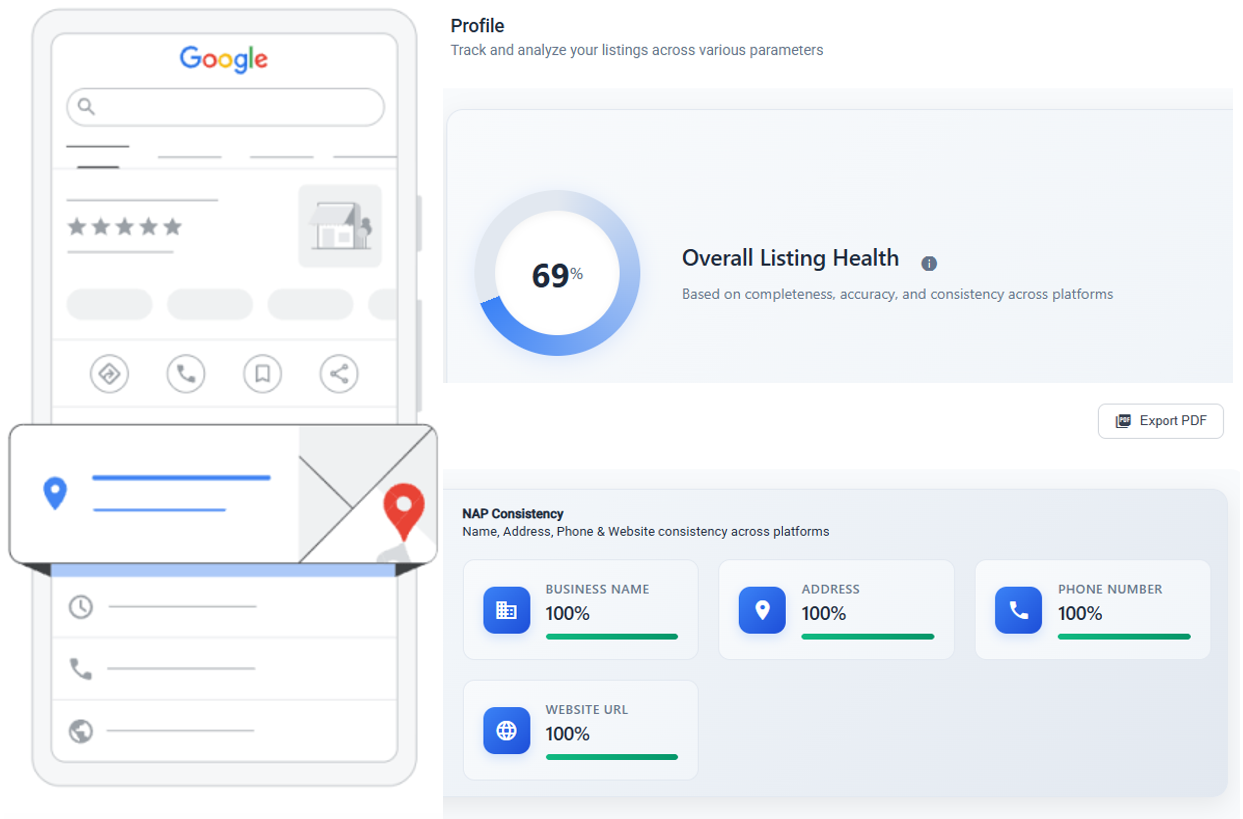
NAP = Name, Address, Phone. It needs to be identical across your GBP profile, your website, and every directory where your business is listed.
Not "mostly the same." Identical. "123 Main St" and "123 Main Street" are different in Google's eyes. "Suite 4" and "#4" are different.
For multi-location brands, inconsistencies multiply. One location might be listed three different ways across 50 directories. That's 150 potential mismatches, just for one location.
What to do: Create a master spreadsheet with the canonical NAP for each location. Then audit every citation source against it. Fix mismatches. This is tedious work, but it directly impacts ranking.
Use Geo-Grid Tracking to Find Weak Spots
Here's something most multi-location brands don't do, and it's the single most actionable thing on this list.
A geo-grid (sometimes called a local rank tracker or heatmap) shows how your business ranks at different points on a map around your location. Instead of checking "do I rank #1 for 'pizza near me'?" it shows you: "I rank #1 when someone is 0.5 miles away, #4 when they're 1 mile north, and not at all when they're 2 miles east."
This tells you exactly where your ranking drops off and in which directions. That's intelligence you can act on.
How to use it:
- Run geo-grid scans for your top 3-5 keywords at each location
- Identify locations where ranking drops off quickly (small radius of visibility)
- Compare strong locations to weak ones. What's different? Usually it's reviews, categories, or content freshness.
- Track changes over time. Did that batch of new reviews expand your ranking radius?
BizLoc8 includes geo-grid tracking built into the platform. You can scan all your locations, compare them side by side, and see exactly which ones need attention. See current pricing for plans that include geo-grid scans.
Build Citations Strategically
Citations are mentions of your business name, address, and phone number on other websites. They're a prominence signal.
The big directories matter most: Yelp, Apple Maps, Bing Places, Facebook, Yellow Pages, industry-specific directories. For each location, you want consistent listings across all of them.
For multi-location brands: Start with the top 30-40 general directories for all locations. Then add industry-specific ones. A chain of dental offices should be on Healthgrades, Zocdoc, and Vitals. A restaurant chain should be on TripAdvisor, OpenTable, and Zomato.
Don't chase quantity. 40 high-quality, consistent citations beat 200 low-quality, inconsistent ones.
Earn Local Links
Backlinks still matter for local SEO, but they need to be locally relevant. A link from the New York Times is great for your domain authority, but a link from the local Chamber of Commerce or a neighborhood blog directly impacts your local ranking.
Tactics that work for multi-location brands:
- Sponsor local events -- most event pages link to sponsors
- Join local business associations -- Chamber of Commerce, business improvement districts
- Partner with local charities -- donation pages often link to donors
- Create locally relevant content -- "Best parks near our [City] location" type pages
- Get local press coverage -- new location openings, community involvement
The key is doing this per location, not just at the corporate level. A link to your homepage doesn't help your Denver location rank. A link from a Denver community blog to your Denver landing page does.
How to Diagnose Ranking Issues
When a location isn't ranking well, don't guess. Diagnose systematically.
Step 1: Run a Geo-Grid Scan
See how far your ranking extends from the location. If it drops off within a half-mile radius, you have a prominence problem. If it ranks well nearby but not for certain keywords, you have a relevance problem.
Step 2: Compare to a Strong Location
Pick a location that ranks well. Compare the two profiles side by side:
- Review count and recency
- Number and quality of photos
- Google Post activity
- Categories and attributes
- Website link (location page vs. homepage)
- Citation consistency
Usually the gap is obvious once you look.
Step 3: Check for Technical Problems
Some ranking issues aren't about optimization at all:
- Duplicate listings -- a second, unverified listing for the same location splits your signals
- Suspended profiles -- might not be visible to you but are invisible to searchers
- Google-suggested edits -- if someone suggested a change and Google accepted it, your data might be wrong
- Wrong map pin location -- the pin is in the wrong spot, so distance calculations are off
Step 4: Look at the Competition
Search your target keyword in that location. Who's in the 3-pack? Study their profiles. You might find that the competition in that area is simply stronger, and you need to invest more in reviews, content, and citations to compete.
Common Mistakes That Kill Multi-Location Rankings
Duplicate Listings
This is the most common issue we see. A location moves, or someone creates a new listing instead of updating the old one. Now there are two listings for the same business. Google doesn't know which one is real. Both rank poorly.
Fix: Search for your business name + city in Google Maps. If you see duplicates, claim them and mark them as duplicate through the GBP dashboard, or request removal via Google support.
Wrong or Overly Broad Categories
Using "Medical Center" when you should use "Urgent Care Center." Using "Restaurant" when you should use "Thai Restaurant." Every degree of vagueness costs you ranking potential.
Ignoring Reviews
Not just failing to respond -- failing to generate new ones. A profile with an average review from 2024 and nothing new signals to Google that the business might not be active. Fresh reviews are a strong freshness signal.
Same Content Everywhere
Same Google Posts across all locations. Same business description. Same photos. Google can tell. And it doesn't reward duplication. Localize everything you can -- even small differences help.
No Location-Specific Landing Pages
Linking all GBP profiles to your homepage is a missed opportunity. Each location needs its own page with unique, locally relevant content.
Set-and-Forget Mentality
GBP optimization isn't a project with a finish date. It's ongoing. The brands that rank consistently are the ones that treat their profiles like living assets: updating, posting, responding, and monitoring continuously.
Your Action Plan
If you manage multiple locations and want to improve your Maps ranking, here's the order of operations:
- Week 1: Audit all profiles for completeness. Fix NAP issues, categories, and hours. Remove duplicate listings.
- Week 2: Set up review generation at all locations. Start responding to every review within 24 hours.
- Week 3: Run geo-grid scans for your top keywords at every location. Identify the bottom 20% performers.
- Week 4: Build or improve location-specific landing pages. Add schema markup. Set up UTM tracking.
- Ongoing: Publish Google Posts weekly. Monitor reviews daily. Run geo-grid scans monthly. Audit citations quarterly.
This isn't complicated. It's just a lot of work when you have dozens or hundreds of locations. That's where having the right tools makes the difference between doing this well and not doing it at all.
BizLoc8 was built specifically for multi-location brands that need to manage GBP profiles, track rankings, and monitor reviews at scale. Check out how our listing management tools work, or see current pricing to find the right plan.
For more on building a complete hyperlocal marketing strategy, read our pillar guide. And if you're still getting up to speed on GBP basics, start with our guide on what Google Business Profile actually is and why it matters.
The brands winning in Google Maps aren't doing anything secret. They're doing the work, consistently, at every location. Start with the locations that need it most and expand from there.
Related Articles