
It's the monthly client call. Rankings are up, the traffic chart looks fine, and you're about two minutes from wrapping. Then the client says it: "I asked ChatGPT for the best accounting firm for small businesses, and it named Northgate. Not us. Why?" You say "great question," promise to look into it, and move on. Everyone on the call hears the stall.
You'll get this question again. Maybe from a different client, maybe from your own boss after a weekend of playing with ChatGPT. Either way you need an answer that isn't a shrug, and isn't a promise you can't keep.
The honest answer: AI doesn't rank pages, it repeats the web
Google ranks pages. ChatGPT, Gemini and Perplexity mostly don't work that way. When someone asks "who's the best accounting firm for a small business," the engine builds an answer from what the wider web keeps saying. If a competitor shows up on "top 10" lists, review platforms, comparison articles and directories, the AI picks up on that and repeats the name. A good website helps. On its own, it rarely decides the answer.
Two more things clients usually don't know:
- The answer varies. ChatGPT, Gemini and Perplexity often name different businesses for the same question. So do different cities, and small changes in wording ("best" vs "affordable" vs "near me").
- One chat proves very little. The client saw one answer, from one engine, in their own account, on one day. It's a real signal, but it's one data point.
So that's the why. The client cares more about what you'll do about it. We've written separately about what AI engines actually cite when they talk about a brand, if you want the background before the call.
Five steps to answer it properly

1. Reproduce it, properly
Don't open ChatGPT and type the question once. Run the same question, and a few close variations, on ChatGPT, Gemini and Perplexity, in every city the client cares about. Now you know if the competitor wins everywhere, or only on one engine in one town. Those are very different conversations.
2. Find which sources the AI cited
Perplexity lists its sources, and when ChatGPT or Gemini search the web they can show the sources they used. Write down every page that was cited: lists, review sites, directories, comparison posts, news. These are the pages shaping the answer.
3. Find where the competitor is listed and your client is not
Go through the cited sources one by one. On which of them does the competitor appear? On which is your client missing? In my experience this gap table is most of the explanation. Clients get it instantly, because it's a list of places, not a theory.

4. Agree a fix plan
The plan usually has three parts. Get the client onto the lists and platforms the engines cite (pitch list authors, claim review profiles, fix directory entries). Fix the client's own site so it states clearly what they do, for whom and where, with schema markup that backs it up. And build reviews, steadily, on the platforms that keep showing up.
5. Re-run and report the change
Run the same prompts, on the same engines, in the same cities, after the work has had time to land. Show the before and after. Do this well and the awkward question becomes a piece of work the client wants you to keep doing.
How to run these five steps in BizLoc8
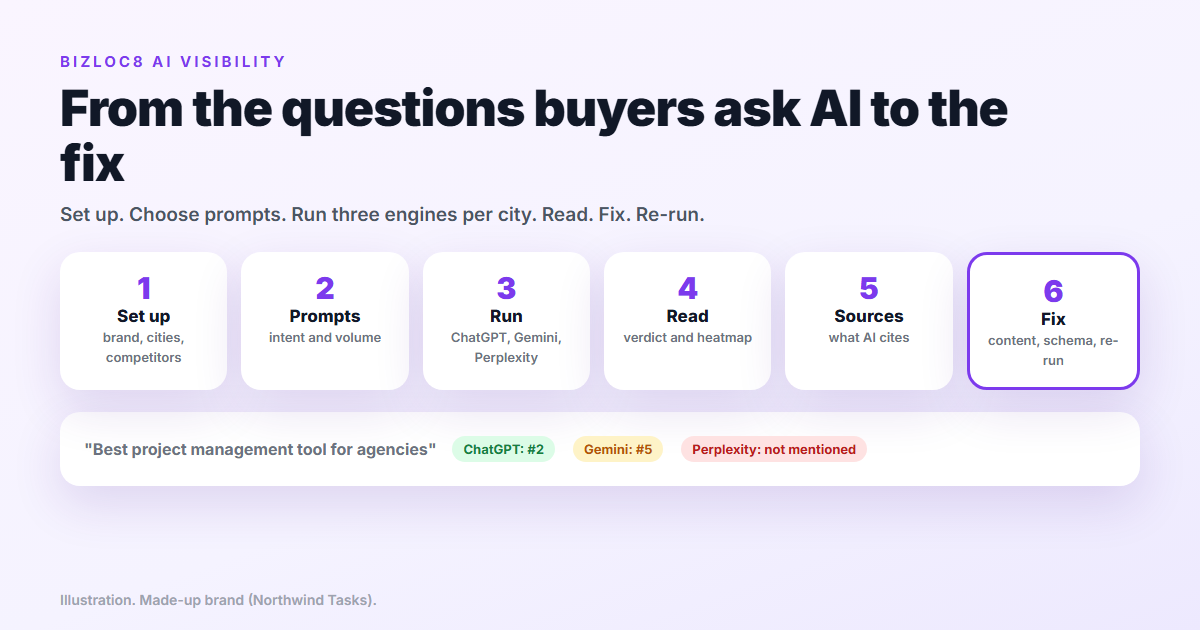
You can do all of this by hand. Three engines times five cities times a dozen prompts is 180 answers, though, and nobody enjoys reading 180 answers. This is how it maps to BizLoc8 AI Visibility.
- Set up the client as a project. Add the website, brand, country, languages and the cities they serve. BizLoc8 suggests prompts (the questions buyers ask AI), each tagged with intent and search volume, or you write your own, like the exact question the client typed. Competitors are discovered for you or added by hand. Each brand you manage is its own project, and you can give teammates access.
- Reproduce it across engines and cities. Run the prompts on ChatGPT, Gemini and Perplexity. You get one answer per engine, per city, per prompt, and the dashboard shows whether the client is mentioned, at what position, and which competitors are named instead, engine by engine and prompt by prompt.
- See the cited sources. Cited sources are broken down by engine and by prompt, so you can see exactly which pages fed the answer the client saw.
- Find the gap. Action Items list each cited domain with its role, its authority, whether the client is present, which competitors are, and which engines cite it, plus a citation strategy for getting on it. That's the gap table from step 3, done for you.
- Fix the site. Generate page copy, schema JSON-LD and meta tags for the client's pages, and run the Website Audit for technical, schema and content gaps.
- Share it with the client. Export the AI Visibility PDF for where things stand and the AI Strategy PDF for the plan. Both are easy to drop into the next monthly call.
- Re-run and compare. Run all prompts again on demand (or just one engine, or selected prompts) and show the change in rank over time.
For the full product tour, see how BizLoc8 AI Visibility works. If you just want to see the problem for one client first, the free AI Visibility audit runs on ChatGPT with no signup to start, and shows the competitors ahead and the cited domains.
What to say on the call
"Good catch, and you're not imagining it." AI tools don't rank websites the way Google does. They repeat the businesses the rest of the web keeps mentioning: lists, review sites, comparison articles, directories.
"One answer isn't the full picture." ChatGPT, Gemini and Perplexity often give different answers, and it changes by city and by how the question is worded.
"Here's what we'll do." We'll run your key questions across all three engines in each of your cities, find the sources they're quoting, and show you where Northgate is listed and you're not.
"Then we fix the gaps and measure it." At the next call you'll get the report, the plan, and a date when we re-run everything to show what moved.
There's no promise of "number one in ChatGPT" in there. Nobody can honestly make one.
Mistakes that make this conversation worse
- Promising rankings in ChatGPT. You don't control the answer. You control how often the client shows up in the sources the answer is built from. Sell that.
- Checking once in your own logged-in chat. Your account has history, location and settings. One chat in it tells you what you saw, not what the client's buyers see. Test across engines, cities and wordings.
- Treating it as just SEO. Good rankings help, but the fix is mostly off the client's site: third-party lists, reviews, directories, comparisons. If your plan is only "more blog posts," expect the same answer next month.
- Saying "great question" and waiting for them to forget. They won't. They'll ask ChatGPT again next week, and then ask you again.
Frequently asked questions
Why does ChatGPT recommend my competitor instead of me?
ChatGPT usually recommends a competitor because that competitor appears on more of the pages it draws from: best-of lists, review platforms, comparison articles and directories. AI engines repeat the businesses the wider web keeps mentioning, so a competitor with more third-party mentions tends to get named more often. A good website helps, but on its own it rarely decides the answer.
Do ChatGPT, Gemini and Perplexity give the same recommendations?
ChatGPT, Gemini and Perplexity often do not give the same recommendations. The same question can name different businesses on each engine, and the answer can also change by city and by small changes in wording, such as best versus affordable versus near me. That is why one manual check is not enough to tell a client where they stand in AI answers.
Can an agency guarantee a client gets recommended by ChatGPT?
No agency can guarantee that ChatGPT recommends a client, because nobody controls what an AI engine says. What an agency can do is measure where the client shows up across ChatGPT, Gemini and Perplexity, find the cited sources the client is missing from, fix those gaps, and re-run the same prompts to show the client what changed.
Is getting recommended by AI the same as SEO?
Getting recommended by AI overlaps with SEO, but it is not the same thing. Good rankings and a clear website help, yet ChatGPT, Gemini and Perplexity lean heavily on third-party sources like lists, review sites and directories. So most of the work to get recommended by AI happens off the client's own site, on the pages the engines cite.
How do I check which sources ChatGPT cited about my client?
To check which sources ChatGPT cited, run the question with search on and note every link it shows, then repeat on Gemini and Perplexity and in each city the client serves. BizLoc8 AI Visibility does this across all three engines and shows cited sources by engine and by prompt, with Action Items for the domains the client is missing from.
What should an agency tell a client who asks why ChatGPT recommends a competitor?
Tell the client that AI tools repeat the businesses the rest of the web keeps mentioning, and that one answer from one engine is not the full picture. Then promise a process, not a ranking: run their key questions on ChatGPT, Gemini and Perplexity in each city, find the cited sources, close the gaps, and re-run to show what moved.
Is there a free way to see which competitors ChatGPT recommends over my client?
Yes. The free AI Visibility audit at audit.bizloc8.ai runs on ChatGPT with no signup to start, and there is a daily limit. It shows the brand's mention rate, average rank, the competitors ahead, prompt-by-prompt results and the domains ChatGPT cites with competitor presence. Gemini and Perplexity results unlock with an email or a free trial.
Related Articles